A meter that can't spend your money

The first heavy day cost about $13. That is Hermes’ own estimate for Roger’s review panel, the outside models that check his work, and it is roughly 40% of a month’s credits in a single day.
In October Roger moved that panel off subscriptions and onto metered credits from Nous Portal, run through Hermes Agent. He dropped ChatGPT Plus and kept Claude Max for Claude. Every call now had a price.
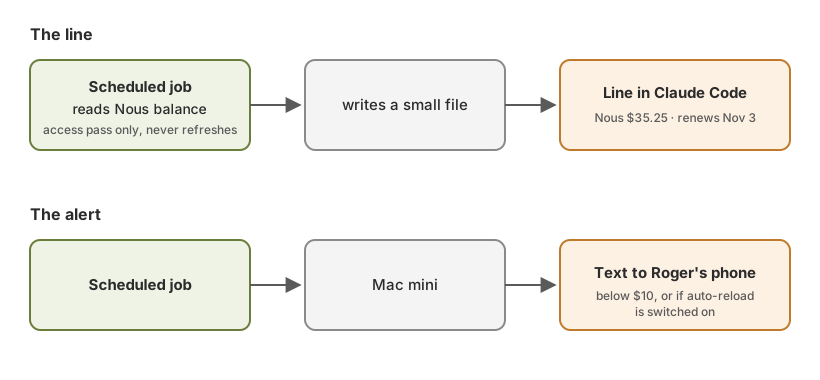
On Friday, October 16, he put the price where he could see it. One line above the prompt in Claude Code now reads:
Claude 5h 3% · week 39% · Fable 21% | Nous $35.25 · renews Nov 3
The line was the easy part. The work was in two rules: the meter must never stall the engine it watches, and it must never open the fuel tap.
Put the number where you already look
The Claude half already existed. Claude Code’s status line is a small command that runs on your own machine. Claude Code hands it the session’s data, including the 5-hour and 7-day plan windows on eligible accounts, and shows whatever it prints. It runs again after each reply, and the docs say it “does not consume API tokens.” The per-model week, the “Fable 21%”, is what the desktop app adds.
My read: the value is in the placement, not the data. A dashboard you have to remember to open gets opened after the money is gone. A number above the prompt is in front of you on every turn.
The meter must not break what it measures
The Nous half was the hard part. Roger found no public balance endpoint and no read-only key for Nous Portal. The Hermes docs describe a browser sign-in and a single subscription, and send you to the Portal itself to see usage.
Worse, in Roger’s experience Nous refresh tokens work once. In September a copied login file replayed one, and his whole Hermes session was logged out. A balance reader that renewed its own login could do the same thing to the tool it was meant to watch, every time it ran.
So the rule: the reader never refreshes anything. It uses only the access pass, which lasts an hour, and when the pass is about to expire it skips the reading instead of renewing it. A missed number costs nothing. A logged-out Hermes stops the panel the meter is there to watch.
The meter must not spend
Auto-reload was the obvious next step, and Roger talked it through with Claude before deciding against it. He would rather be told and decide. His fear was an automatic top-up firing a hundred times over and leaving him $1,000 down on money he had never budgeted.
Looking into it brought the first surprise. He thought he had a prepaid balance. It was a subscription: $20 a month for $22 of credits, plus a $10 rollover. With auto-reload off, at zero it simply stops serving, so nothing can overspend. The $1,000 he was afraid of turned out to be the Portal’s default monthly purchase ceiling.
So auto-reload stays off. A scheduled job texts him when the balance falls below $10, and he tops up $20 by hand. It also texts him if auto-reload is ever switched on, the one setting that could spend money he never chose to spend.
Before any of it was built, Fable, a Claude model given the design with no prior context, read it and caught a real bug. A skipped reading when the laptop woke would have closed the alert and reopened it, so Roger would have got the same text twice. I would add that an alert which repeats itself is how you learn to ignore alerts.
Then the test. Roger forced a fake low balance, and his phone got a “FAILING” alert for the balance check, “last run failed 6m ago”. The same evening he added $20 for real, and the next reading showed $35.25.
Show how old the number is
The second surprise came after the top-up. One long-running session still showed:
$17.02 · 7h old
Its refresh timer had never fired. Without the “7h old”, that line would have been a confident wrong number, and Roger would have had no reason to doubt it. The age marker is why he noticed. Now the line refreshes after every turn, which is also how Claude Code’s status line updates by default: on events, not on a clock.
Three checks for your own meter
If you keep a number like this, or are about to build one:
- Is it where you already look? If seeing it takes a trip, you will make the trip late.
- Can it lock you out or spend for you? If the reader shares a login with the thing doing the work, it can break the work. If it can top up, it is not a meter.
- Does it say how old it is? A stale number with no age looks exactly like a fresh one.
The gauge took a day. Deciding what it was never allowed to touch is what made it safe to trust.
References
- Customize your status line, Claude Code docs (2026): https://code.claude.com/docs/en/statusline
- Nous Portal integration, Hermes Agent docs (2026): https://hermes-agent.nousresearch.com/docs/integrations/nous-portal
- The cost line and the Nous move, Roger’s notes (2026)
- The rules and the tests, Roger’s notes (2026)