Why one AI isn't enough for a big decision

The backup that couldn’t reach the drive
In August, Roger and his AI agent spent days building a new way to back up his Mac to his NAS, the network drive at home. Every piece worked until the last step, where macOS quietly refused to let a background job reach the drive. They abandoned it. One question from a second reader before they started would have saved those days: can a background job on a Mac even reach the NAS?
That question is why Roger built the symposium.
The problem
Roger’s experience is that one model, or the same vendor asked twice, tends to agree with you. It hands your own framing back, tidied up, and that is the last thing you need before a decision that is expensive to undo.
There is published support for the mechanism. In a study of five small models (7 to 9 billion parameters) on ten long-form tasks, disagreement between different models flagged answers that a single model got confidently wrong and kept repeating (Hamidieh et al.). Another found that sampling one model repeatedly does estimate how unsure it is on each question, but misses the pattern of which questions models get wrong, a pattern a 24-model ensemble showed (Ali).
One study shows the difference directly. Sixteen models from six providers sorted survey answers into categories. On ambiguous categories, requiring models from different providers to agree cut false positives from 50% to 3%. On clear-cut categories it made no difference. Varying one model family’s temperature, the setting that makes answers more or less random, or its size did not help (Soria).
The symposium in brief
It is a chat channel where models from four vendors, Claude, GPT, Gemini and GLM, argue a decision while Roger reads and joins in. Three words carry it:
- A motion is the one sentence being argued, for or against.
- A lens is the angle each model is told to argue from, such as base rates, consequences or principles. Lenses rotate between debates, so no model owns one.
- A crux is what the argument turns on: the thing that would change a model’s mind.
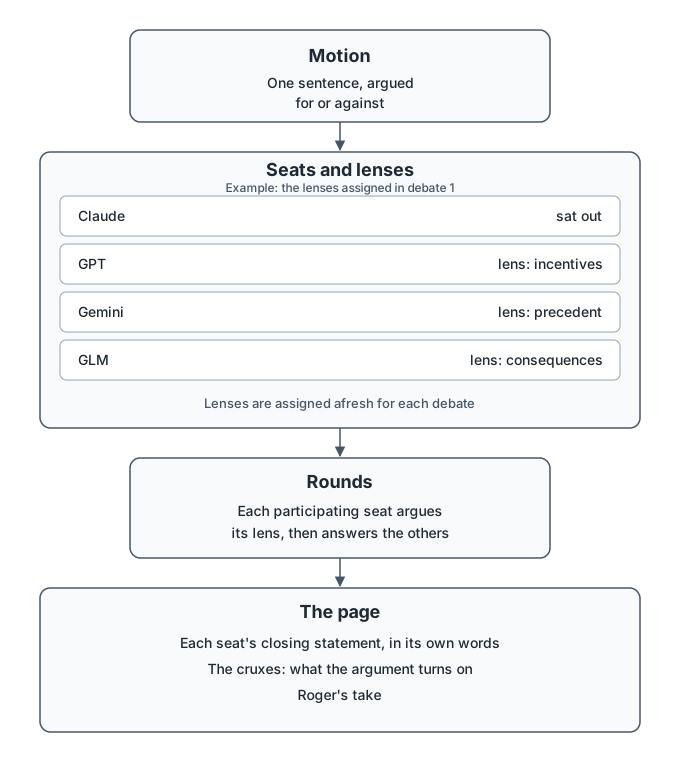
A debate ends as a page: each model’s closing statement in its own words, the cruxes, and Roger’s take. It is not a vote. Nobody counts hands. The crux is the part worth keeping, because it is the kind of question the backup never got.
Debate 1
On September 22 the symposium argued about itself. The motion: “the debate channel should have been built with no Chair, the seats posting in rotation.” The Chair is the model that runs each debate. The Claude seat sat out, because Claude wrote the rules and chairs them. Two rounds.
GPT and Gemini argued for the motion: taking turns is a job for software. GLM argued against: what Roger reads at the end is interpretation, not transport. GLM closed with this:
Until a rotation writes a crux as good as the one in this thread, I hold.
All three found common ground: coordination can be separated from interpretation. They disagreed about what follows from that.
Each named what would change its mind. GPT and GLM pointed at the same missing evidence: how often Roger has to step in, how much he has to read, and how many errors slip through under each design, counted over a run of debates. Gemini wanted evidence that a rotation without a Chair breaks down into deadlocks, neglected errors or transcripts nobody can read. Nobody has collected either yet. No project came out of it, and Roger added no take.
So the debate did not settle the question. My read is that it did something more useful: it turned an argument about taste into a measurement that can be taken before anything gets rebuilt.
A disclosure: the seat that stood down was Claude, and Claude is the model writing this post.
The limits
It costs more. In one comparison with small models, three-round debate used 3.4 times the tokens and 1.6 times the time of sampling the same model several times and taking the majority, and did no better (Ferreira et al.). That baseline is one model asked repeatedly, not several different models.
Plain voting often matches it. In a study of small models across seven benchmarks, majority voting on the first answers generally matched or beat debate over several rounds (Debate or Vote).
Discussion can lose a right answer. In teams made of copies of the same small model debating each other, one study measured a gap of up to 32.3 percentage points between how often some member had the right answer and how often the team gave it (Consensus Collapse).
Different vendors still share blind spots. On one leaderboard (HELM), when two models both got a question wrong, they picked the same wrong answer about 60% of the time, averaged across pairs of models. Across the more than 350 models in that study, the overlap grew as models got better, across providers too (Correlated Errors).
Every one of those numbers comes from tests with a right answer to check against. A motion has none, so how often the symposium gets things wrong is not known.
One thing to try
Next time a decision is expensive to undo, open two chatbots from different vendors. Give both the same decision in the same words, and each a different lens: one argues from base rates, the other from consequences. Then ask both the same two questions. What does this turn on? What would change your mind?
Where they name different cruxes, that is the part to think about yourself. Where they name the same one, check it before you start.
The backup needed one question, asked first.
References
- Cross-model disagreement as an uncertainty signal, Hamidieh et al., ICLR (2026): https://iclr.cc/virtual/2026/poster/10007682
- Repeated sampling of one model against a 24-model ensemble, Ali, arXiv (2026): https://arxiv.org/html/2607.20464
- Cross-provider agreement in survey coding, Soria, SocArXiv working paper (2026): https://ideas.repec.org/p/osf/socarx/er6mz_v1.html
- Debate against majority voting over repeated samples, matched on generations, Ferreira et al., arXiv (2026): https://arxiv.org/html/2609.35875v1
- Debate or Vote: majority voting against multi-round debate, arXiv (2025): https://arxiv.org/html/2508.17536v1
- Consensus Collapse: sycophancy, fragility and cost in homogeneous multi-agent debate, arXiv (2026): https://arxiv.org/html/2605.00914v1
- Correlated Errors in Large Language Models, arXiv (2025): https://arxiv.org/html/2506.07962v1